
Our quality products and best service will make your business much better.
Professional . Specialized . Experienced
(English)

29
Dec
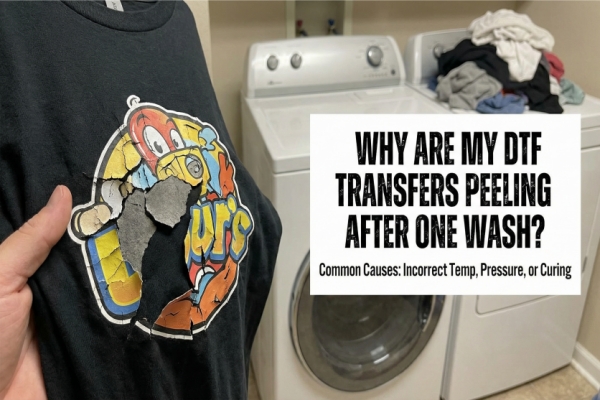
Seeing a perfect design peel off after just one wash can be incredibly frustrating. In direct-to-film (DTF) printing, this is typically caused by specific technical variables in the production process.
However, by mastering your curing temperature and application technique, you can ensure that your transfers remain vibrant and intact through dozens of laundry cycles. Here are seven professional solutions to improve wash fastness and durability:
1. Optimise your curing temperature
The most common cause of peeling is under-cured adhesive powder. If the powder does not reach its full melting point, it will not create a permanent bond with the ink or the fabric.
The goal is to achieve a 'glossy orange peel' finish on the back of the film.
The solution: ensure your oven or shaker reaches 110–125°C. If the powder still looks 'grainy' or sandy after curing, increase the curing time by 30 seconds.
2. Check your heat press pressure.
Even a perfectly cured film needs physical force to 'bite' into the microscopic fabric fibres.
The fix: Use medium-to-high pressure (approx. 40–60 PSI). If you can easily pull the film off the garment with no resistance before peeling, the pressure is too low.
3. Eliminate fabric moisture (the pre-press)
Natural fibres such as cotton hold moisture that you can't see. During heat pressing, this moisture turns into steam, which can push the adhesive away and prevent a clean bond.
The fix: Always pre-press your garment for 5–8 seconds to remove moisture and flatten stray fibres before laying down your transfer.
4. Verify the peel temperature.
Different films have different chemical properties. Peeling a cold-peel film while it is still warm will destroy the adhesive bond instantly.
The fix: Check your film's specifications. For cold-peel films, wait until the film is completely cool to the touch. For hot-peel, remove it immediately after the press opens.
5. The power of the 'second press'
A 'finishing press' is the secret to achieving industrial-grade durability. This helps the DTF ink and adhesive to settle deeper into the texture of the shirt.
The fix: After removing the PET film, cover the design with parchment paper or a Teflon sheet and press again for 5–10 seconds.
6. Use high-purity adhesive powder.
Not all TPU powders are created equal. Low-quality powders often have a lower resin count, resulting in a weaker bond that will fail in the wash.
The solution: Use a standardised, high-purity TPU powder. Store your powder in a dry, climate-controlled environment with a humidity level of 40–60% to prevent clumping.
7. Proper laundry aftercare
Sometimes the issue occurs during the washing process. Harsh chemicals and high heat can break down even the best transfers.
The solution is to instruct customers to wash the garment inside out, use cold water and avoid bleach. To maximise the garment's lifespan, it is preferable to hang it rather than tumble dry it on a high heat setting.
Reliability through standardised production
Durability starts with standardised production. By using equipment that undergoes rigorous quality inspection, you can be sure that you are eliminating the guesswork that leads to peeling. Consistent heat, even pressure and high-grade consumables result in excellent wash fastness and a premium feel.


