
Our quality products and best service will make your business much better.
Professional . Specialized . Experienced
(English)

08
Jan
.jpg)
The global digital textile printing market is no longer defined solely by speed and color brilliance. As we move into 2026, the industry has reached a tipping point where environmental stewardship is as critical to a business's survival as its profit margins. Direct-to-Film (DTF) printing, while revolutionary for its versatility, is now under intense scrutiny regarding its chemical footprint and waste management.
For print shop owners and industrial manufacturers, the transition to sustainable DTF consumables is not merely an ethical choice—it is a strategic pivot to comply with tightening international regulations and to capture the growing "conscious consumer" market.
In recent years, the legal landscape for textile production has shifted dramatically. The EU's "Strategy for Sustainable and Circular Textiles" and the ESPR (Ecodesign for Sustainable Products Regulation) have set a clear mandate: products sold in major markets must be durable, repairable, and free of hazardous substances.
By 2026, having Oeko-Tex® Standard 100 or GOTS (Global Organic Textile Standard) certification for your consumables will be a prerequisite for working with high-end retailers. These certifications guarantee that every drop of ink and every gram of powder is free from harmful levels of over 100 substances, including phthalates and formaldehyde. Shops that fail to adapt now risk being locked out of lucrative B2B contracts.
The most significant environmental impact in DTF comes from the ink chemistry. Traditional solvent-based systems often release Volatile Organic Compounds (VOCs) during the curing process, which pose respiratory risks to operators and contribute to atmospheric pollution.
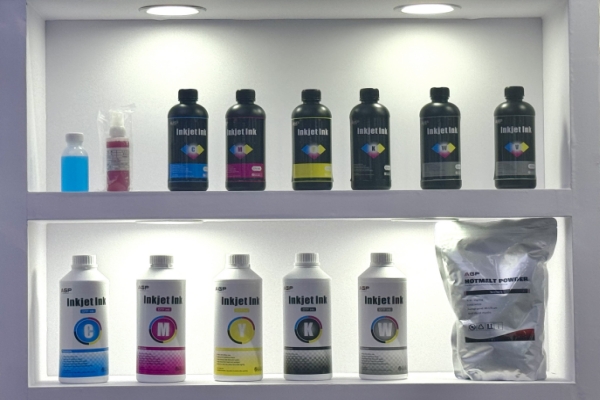
Modern sustainable water-based DTF inks are high-performance dispersions that utilize purified water as the primary carrier.
Superior Molecular Bonding: 2026 ink technology has solved the "vibrancy gap." High-pigment loading ensures that water-based formulas deliver colors that are just as saturated as traditional inks.
Safety & Skin Comfort: Because these inks lack harsh solvents, the finished garment is safer for sensitive skin, making them ideal for infant wear and intimate apparel.
Printhead Longevity: Water-based chemistries are generally less abrasive, which supports standardized production by reducing the frequency of printhead cleanings and replacements, thereby reducing physical electronic waste.
The PET (Polyethylene Terephthalate) film is often seen as the "disposable" part of the process, but it represents a massive opportunity for waste reduction.
Recycled Content (rPET): Top-tier manufacturers are now producing films using up to 50-70% post-consumer recycled plastic. This significantly lowers the carbon intensity of the manufacturing process.
Anti-Static Bio-Coatings: Traditional films use silicone-based release agents that can be difficult to break down. The new generation of sustainable DTF films uses plant-derived coatings that maintain the same high-definition ink absorption while being more compatible with industrial recycling streams.
Matte vs. Glossy Sustainability: Newer matte-finish films are being developed to require fewer chemical coating layers, further reducing the material's environmental impact.
Adhesive powder (TPU) is what gives DTF its legendary durability. The transition to sustainable adhesives focuses on energy efficiency and chemical purity.
One of the hidden costs of DTF is the energy used in curing ovens. Sustainable TPU powders are now engineered to have a Lower Melt Point (LMP).
The Benefit: By reducing the required melt temperature from 150°C to 110°C - 120°C, print shops can reduce their energy consumption by up to 20%.
Standardized Efficiency: Utilizing automated powder shakers with infrared heating ensures that 99% of excess powder is reclaimed and reused, embodying the "zero waste" principle of a circular economy.
Many businesses hesitate to switch due to perceived costs. However, a deep Return on Investment (ROI) analysis reveals that sustainable practices drive profitability:
Brand Loyalty: Surveys show that 75% of Gen Z consumers prefer to buy from brands with a proven commitment to sustainability.
Operational Savings: Reduced energy use and less ink waste directly impact the bottom line.
Future-Proofing: Businesses that transition now avoid the "panic costs" of rushing to meet sudden regulatory changes in the future.
At TEXTEK, we recognize that sustainability cannot come at the expense of quality. Every eco-conscious consumable we supply undergoes rigorous quality inspection. We test for:
Excellent Wash Fastness: Ensuring that eco-friendly prints last for 50+ washes without degradation.
Color Consistency: Guaranteeing that "Green" inks produce the same "Red" and "Blue" that your customers demand.
Transitioning to sustainable DTF consumables is a journey of continuous improvement. By integrating these high-standard materials into your standardized production workflow, you are not just printing designs—you are printing a better future for the textile industry.


