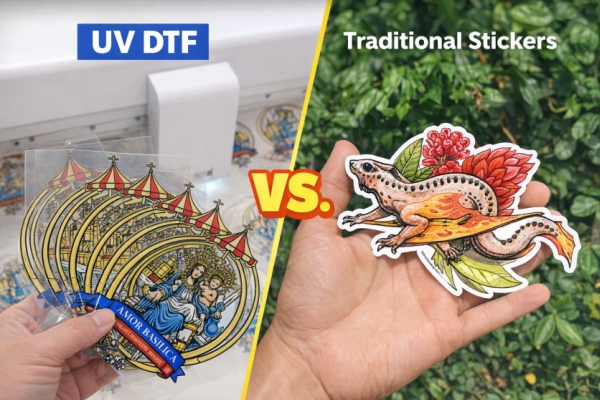
In the rapidly evolving world of product customization and brand marketing, choosing the right labeling technology can make or break your brand's visual identity. While traditional vinyl stickers have been the industry standard for decades, a new contender—UV DTF (Ultraviolet Direct-to-Film)—is revolutionizing how businesses approach branding on hard surfaces.
But which one is truly better for your brand? In this comprehensive guide, we'll break down the technical differences, durability, and aesthetic impact of UV DTF versus traditional stickers to help you make an informed decision.
What is UV DTF Printing?
UV DTF is a hybrid printing technology that combines the precision of UV-curable inks with the versatility of transfer films. Unlike traditional methods, the design is printed onto a specialized "A" film, cured instantly with ultraviolet light, and then laminated with a "B" film. The result is a high-quality, "peel-and-stick" transfer that can be applied to almost any hard surface without the need for a heat press.
What are Traditional Stickers?
Traditional stickers, typically made from adhesive vinyl (such as PVC or PET), are printed using solvent, eco-solvent, or latex inks. These are often die-cut into specific shapes and applied directly to surfaces. While versatile, they rely on a top-down adhesive layer and often require a laminate coating to achieve high durability.
Technical Comparison: UV DTF vs. Traditional Stickers
|
Feature
|
UV DTF Transfers
|
Traditional Vinyl Stickers
|
|
Aesthetic Effect
|
3D Embossed / Raised Texture
|
Flat / 2D Finish
|
|
Color Vibrancy
|
High (UV-curable inks)
|
Moderate to High
|
|
Application
|
Transfer-based (No background)
|
Direct-stick (Visible edges)
|
|
Durability
|
Scratch, UV, and Water Resistant
|
Weatherproof (with lamination)
|
|
Surface Versatility
|
Irregular, Curved, Hard Surfaces
|
Mostly Flat or Slightly Curved
|
|
Tactile Feel
|
Premium, Tactile Texture
|
Smooth, Plastic Feel
|
Why UV DTF is Winning the Branding Game
1. The "No-Label" Look
One of the biggest advantages of UV DTF for branding is the seamless finish. Traditional stickers often have a visible white or clear border around the design. UV DTF transfers only the ink and varnish to the surface, giving your products a professional, "printed-on" look that mimics high-end screen printing or direct UV flatbed printing.
2. Superior Tactile Experience
Branding is about more than just sight; it's about touch. UV DTF enables varnish layering, resulting in a raised, 3D embossed effect. This tactile quality adds a premium feel to promotional items like tumblers, electronic devices, and luxury packaging, making your brand stand out in a crowded market.
3. Unmatched Durability
UV-curable inks are known for their extreme resistance to environmental factors. Once applied, UV DTF transfers are:
•Scratch-Resistant: The cured ink is exceptionally durable and resistant to scratches.
•Waterproof & Dishwasher Safe: Ideal for drinkware and outdoor equipment.
•UV-Resistant: The colors won't fade even under prolonged sunlight exposure.
4. Versatility Across Substrates
Traditional stickers struggle with highly curved or irregular surfaces. UV DTF transfers are flexible during application, allowing them to adhere perfectly to glass, metal, ceramic, wood, and even leather. This makes them the ultimate solution for multi-product branding.
When Should You Stick with Traditional Stickers?
Despite the rise of UV DTF, traditional vinyl stickers still have their place:
•Cost-Effectiveness for Bulk Giveaways: For low-cost promotional handouts like laptop stickers, traditional vinyl is more economical.
•Temporary Branding: If you need labels that are easy to remove without leaving residue, certain removable vinyls are superior.
•Large Surface Coverage: For vehicle wraps or large wall decals, traditional wide-format vinyl remains the standard.
The Verdict: Which is Better for Your Brand?
If your goal is to create a premium, long-lasting, and professional brand image on high-value products, UV DTF is the clear winner. Its ability to provide a 3D tactile effect and a seamless "no-label" look offers a level of sophistication that traditional stickers simply cannot match.
However, for high-volume, low-cost marketing campaigns where durability is less critical, traditional stickers remain a viable and budget-friendly option.
Ready to Upgrade Your Branding?
As consumer expectations rise, the technology you choose to represent your brand matters. UV DTF isn't just a trend; it's the future of hard-surface customization.