
Our quality products and best service will make your business much better.
Professional . Specialized . Experienced
(English)

25
Mar
Investing in a Direct-to-Film (DTF) printer is a significant decision for your custom apparel business. While the vibrant colors and versatility of DTF printing are universal, the hardware you choose dictates your production capacity, overhead, and ultimately, your profit margins. Feeling a bit overwhelmed by the technical specifications is completely normal when you are looking to scale.
If you are stuck deciding between an A3, a 60cm, or a Large Format DTF printer, this guide will break down exactly what you need to know to make the right choice for your specific business goals.
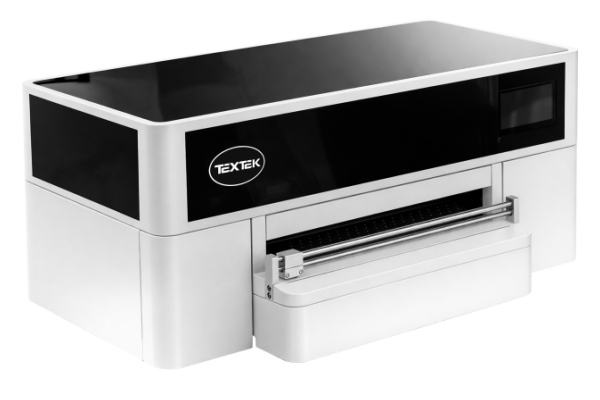
An A3 DTF printer typically handles film widths up to 30cm (about 11.8 inches) or 33cm. These are often referred to as desktop DTF printers.
The A3 size is tailor-made for startups, hobbyists transitioning to a business, and small print shops with limited floor space. If you are producing small batches of custom t-shirts, hoodies, or promotional items, this is your entry point.
Pros:
Low Barrier to Entry: The most budget-friendly option to get started in the DTF industry.
Compact Footprint: Fits easily on a sturdy desk or workbench; no massive warehouse space required.
Easy Maintenance: Generally simpler to operate and maintain for beginners.
Cons:
Lower Production Speed: Not designed for hundreds of daily prints.
Size Limitations: You cannot print oversized gang sheets or massive back-piece graphics efficiently.
.jpg)
A 60cm DTF printer (about 24 inches wide) is the industry standard for growing and established custom apparel businesses. It strikes the perfect balance between high performance and manageable size.
This is the ideal machine for businesses experiencing rapid growth, screen printers looking to add short-run full-color capabilities, and anyone needing to produce large gang sheets for maximum efficiency.
Pros:
High Efficiency: Dual or triple printheads (like the popular Epson I3200) allow for simultaneous white and color printing at impressive speeds.
Gang Sheet Mastery: The 60cm width is perfect for nesting multiple designs onto a single roll, drastically lowering your cost per print.
Excellent ROI: Offers commercial-grade output without the massive footprint of industrial machines.
Cons:
Higher Investment: Requires a larger upfront budget for the printer and the accompanying automatic powder shaker.
Space Requirements: You will need dedicated floor space and proper ventilation for the shaker/dryer unit.
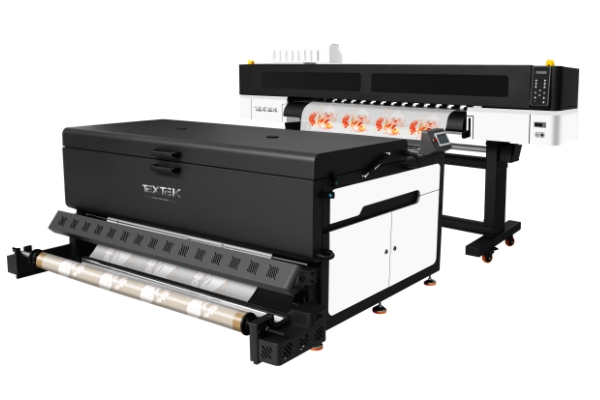
Large format DTF printers step into the 160cm DTF printer or wider territory. These are serious, heavy-duty machines built for continuous, 24/7 manufacturing environments.
Industrial-scale fulfillment centers, massive online apparel brands, and B2B transfer providers who sell DTF gang sheets to other businesses.
Pros:
Unmatched Output: Equipped with 4 or more printheads, these machines output massive volumes at blazing speeds.
Economies of Scale: Yields the absolute lowest cost-per-print when running at full capacity.
Cons:
Premium Price Tag: A major capital expenditure.
Facility Needs: Requires industrial electrical setups, substantial floor space, and professional climate control.
| Feature | A3 DTF (30cm) | 60cm DTF | Large Format (120cm+) |
| Best For | Startups, Boutiques | Mid-to-Large Shops, Gang Sheets | Industrial Fulfillment, B2B Transfers |
| Output Volume | Low to Medium | High | Extremely High |
| Footprint | Desktop/Small | Dedicated Floor Space | Industrial Warehouse Space |
| Initial Cost | $$ | $$$ |
$ |
| Speed | Moderate | Fast | Blazing Fast |
To ground your choice in reality, evaluate these three metrics rather than just looking at the price tag:
Calculate Your Daily Output: Be honest about your current orders. If you process 20-50 shirts a day, an A3 will suffice. If you are pushing 100-300+ daily, a 60cm printer is strictly necessary to keep up without causing bottlenecks.
Evaluate Your Workflow: Do you want to print one-off designs, or do you want to print long rolls of gang sheets that your team can cut and press later? 60cm machines paired with automated powder shakers provide a much smoother, hands-off workflow for rolls.
Future-Proofing: It is generally better to buy a machine with 20% more capacity than you currently need. Upgrading hardware six months after a purchase because you outgrew it is an expensive mistake.
Choosing the right hardware doesn't have to be a guessing game. At TEXTEK, we engineer precision DTF printers across all sizes to ensure you get the perfect balance of speed, color vibrancy, and reliability for your specific business model.


