
Our quality products and best service will make your business much better.
Professional . Specialized . Experienced
(English)

16
Nov
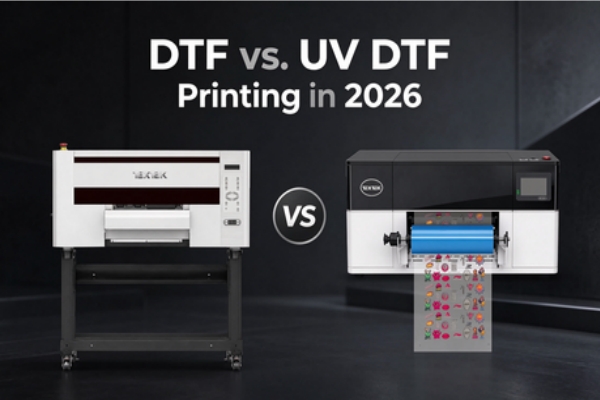
Direct-to-Film (DTF) printing is engineered exclusively for flexible textiles using heat-activated hot-melt adhesive powder, whereas UV DTF printing uses ultraviolet-cured inks and pressure-sensitive A/B films to transfer durable, raised graphics onto rigid, irregular surfaces without heat. Choosing between the two depends entirely on your target substrate: apparel and soft goods require standard DTF, while hard promotional items, glassware, and industrial packaging require UV DTF.
DTF printing transfers water-based pigment inks onto fabrics by curing a hot-melt adhesive powder layer onto a PET film before heat pressing.
The workflow starts by printing CMYK colors followed by a white ink underbase onto coated PET transfer film using a DTF printer equipped with industrial printheads like the Epson I3200-A1. While the ink is still wet, an automated shaker applies hot-melt polyurethane (PU) powder, which then passes through a curing oven at 110°C–130°C to form a flexible adhesive layer. Finally, operators heat-press the transfer onto cotton, polyester, nylon, or blended garments at 150°C–160°C for 10–15 seconds.
UV DTF printing creates cold-transfer "crystal stickers" by printing UV-curable ink and varnish onto an adhesive Film A, laminating it with a carrier Film B, and applying it by hand pressure.
Unlike textile DTF, a UV DTF printer relies on built-in UV LED lamps to cure CMYK, white, and clear varnish inks instantaneously upon contact with Film A (which carries a high-tack pressure-sensitive glue). An integrated laminator binds Film B over the cured ink layer to act as a transfer mask. Once trimmed, the user peels off the Film A backing, presses the graphic onto a hard object, and removes Film B—leaving a scratch-resistant, 3D embossed decal behind with zero heat or curing oven required.
DTF and UV DTF differ fundamentally in ink chemistry, curing mechanisms, substrate compatibility, and finishing effects.
| Comparison Dimension | Standard DTF Printing | UV DTF Printing |
| Ink Chemistry | Water-based textile pigment ink (CMYK + White) | UV-curable acrylic monomer/oligomer ink (CMYK + White +Varnish) |
| Adhesive Mechanism | Heat-activated TPU hot-melt powder | Pressure-sensitive glue pre-coated on Film A |
| Curing Method | Thermal curing tunnel/oven + Heat press | Instantaneous UV LED light exposure |
| Compatible Substrates | Cotton, polyester, blends, denim, nylon, canvas | Glass, metal, acrylic, wood, ceramic, hard plastics, leather |
| Surface Finish | Matte, soft-hand, stretchable fabric feel | Glossy, raised 3D embossed texture (via varnish layer) |
| Wash & Wear Resistance | 50+ machine wash cycles without cracking | Waterproof, UV-resistant, high scratch resistance (hand-wash recommended for drinkware) |
| Required Auxiliary Equipment | Powder shaker, curing oven, heat press | Built-in or standalone cold/warm laminator (no heat press needed) |
Standard DTF delivers higher volume throughput for custom apparel shops, while UV DTF offers higher profit margins per square inch on customized hard goods and short-run packaging.
Choose DTF Printing if: Your primary customer base orders custom T-shirts, hoodies, tote bags, or sportswear. A dual- or quad-head I3200 DTF production line produces continuous roll-to-roll transfers at speeds exceeding 15–25 linear meters per hour, keeping per-print consumable costs low for bulk apparel fulfillment.
Choose UV DTF Printing if: You serve corporate gifting, cosmetic packaging, signage, or drinkware markets. Because UV DTF transfers adhere to curved, cylindrical, and uneven objects (such as tumblers, helmets, and electronics) where flatbed UV printers cannot reach, print shops routinely command 3x–5x markups on custom sticker sheets with zero minimum order quantities.
Can I use a standard DTF printer to print UV DTF stickers? No. Standard DTF printers use water-based inks and lack UV LED curing lamps. Running UV ink through a standard DTF system will clog the printheads and ink lines, and the ink will never dry without ultraviolet light exposure.
Are UV DTF stickers dishwasher safe? UV DTF transfers are waterproof and scratch-resistant, but repeated exposure to high-heat commercial dishwasher cycles can weaken the pressure-sensitive adhesive over time. Hand washing is recommended for tumblers, mugs, and glassware.
Can UV DTF transfers be applied to clothing or fabric? No. UV-cured inks become rigid after curing and lack the elasticity required for textiles. Applying a UV DTF sticker to fabric will cause the graphic to crack, peel, and detach during flexing or washing.
What printheads are best for industrial DTF and UV DTF production? For commercial production, the Epson I3200-A1 (for water-based DTF) and Epson I3200-U1 or I1600-U1 (for UV DTF) provide the optimal balance of high-frequency firing speed, variable droplet precision, and long-term nozzle durability.


