
Our quality products and best service will make your business much better.
Professional . Specialized . Experienced
(English)

03
Mar
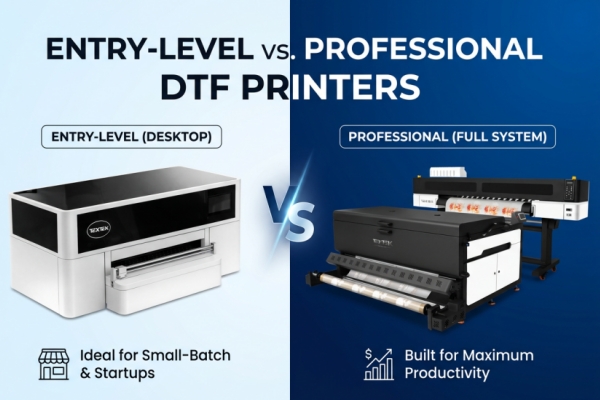
Choosing between an entry-level DTF printer and a professional-grade machine represents one of the most consequential decisions for anyone entering the direct-to-film printing business. The market offers an enormous price range—from budget-friendly starter packages under $3,000 to industrial systems exceeding $15,000—and understanding what separates these categories helps you make an investment that matches your actual needs. This comprehensive guide examines every meaningful difference between entry-level and professional DTF printers, providing the clarity you need to choose confidently.
The distinction between entry-level and professional DTF printers extends far beyond price tags. While both categories can produce quality prints, the differences in components, capabilities, reliability, and support significantly impact your daily operations, production efficiency, and long-term business trajectory. Many new buyers assume expensive equals better, only to discover they've invested in capabilities they don't need—or worse, purchased inadequate equipment that limits their business growth. This guide prevents those costly mistakes by breaking down exactly what you get at each level.
Throughout this analysis, we'll explore technical specifications, real-world performance differences, total cost of ownership considerations, and strategic recommendations for different business scenarios. Whether you're launching your first venture or evaluating an equipment upgrade, this information helps you identify the printer that delivers the best return on your investment.
Before diving into specific differences, establishing clear definitions for what constitutes entry-level versus professional equipment creates a foundation for meaningful comparison. Manufacturers don't always use consistent terminology, so understanding the characteristics that define each category prevents confusion during your search.
Entry-level DTF printers are designed specifically for entrepreneurs just starting their journey in fabric printing. These machines prioritize accessibility—combining reasonable pricing with sufficient capability to produce professional-quality outputs for small-scale operations. They typically feature compact formats, moderate production speeds, and components chosen for cost-effectiveness rather than maximum performance.
Entry-level printers excel at helping new operators learn the craft without requiring massive capital commitment. They're ideal for testing business concepts, developing skills, and building initial customer relationships before scaling operations. However, these machines also carry limitations that become apparent as your business grows and production demands increase.
Most entry-level DTF printers fall in the $2,000 to $4,500 price range, though occasional promotions or bare-bones configurations can dip slightly below this threshold. At this price point, you're getting functional equipment suitable for learning and small-scale production—not industrial-grade machinery designed for demanding commercial environments.
Professional DTF printers represent the next tier of capability, built for operators who need reliable daily production without the limitations of entry-level systems. These machines feature enhanced components, greater production capacity, advanced automation features, and construction designed for extended operational cycles. They serve everyone from growing small businesses to established production facilities.
Professional printers typically range from $5,000 to $15,000, with the most capable systems commanding premium prices. At this investment level, you're getting equipment designed for consistent, daily production—the kind of machine you can rely on to fulfill orders without constant troubleshooting or unexpected category also includes industrial-grade downtime.
The professional systems at the upper end—machines designed for high-volume production environments where throughput and reliability matter more than initial cost considerations. These represent serious investments appropriate for established operations with demonstrated demand.
The printhead stands as the most critical component differentiating entry-level from professional DTF printers. Understanding printhead differences illuminates why pricing varies so dramatically and how different machines perform in real-world conditions.
Most entry-level DTF printers feature smaller-format printheads designed for consumer or light commercial applications. The Epson XP600 appears frequently in this category—a capable printhead that's economical to produce but not designed for the demands of daily commercial printing.
XP600-based systems offer reasonable print quality and can produce impressive results when properly maintained. However, they have smaller ink chambers that require more frequent cleaning cycles, shorter operational lifespans compared to professional options, and limitations on production speed due to their design. For someone printing a few dozen transfers weekly, these limitations rarely impact operations. For growing businesses handling hundreds of prints daily, they become significant constraints.
Some entry-level systems incorporate newer or less-common printhead options, which can offer improved performance but may present challenges around long-term parts availability and support. When evaluating entry-level machines, research the printhead's track record and ensure replacement options will remain available.
Professional DTF printers overwhelmingly feature the Epson i3200 printhead—a workhorse design that's become the industry standard for commercial fabric printing. The i3200 delivers significantly larger ink chambers, extended operational lifespan, faster firing rates, and more consistent droplet placement than entry-level alternatives.
These characteristics translate directly to real-world advantages: higher production speeds without sacrificing quality, longer intervals between maintenance cycles, fewer printhead-related problems, and dramatically extended component life. While i3200 printheads carry higher replacement costs than XP600 options, their longevity often results in comparable or lower total cost of ownership over the printer's useful life.
Professional machines may also incorporate multiple printhead configurations for enhanced production capabilities—dual-head setups that nearly double throughput or enable simultaneous white and color printing. These configurations dramatically accelerate production for high-volume operations.
The performance gap between entry-level and professional printheads becomes most apparent during extended production runs. An entry-level machine handling a large order may require multiple cleaning cycles, experience quality degradation as components heat up, or simply take dramatically longer to complete. Professional equipment maintains consistent output hour after hour.
Speed matters significantly in commercial printing operations, but understanding the nuances of speed specifications helps you evaluate whether a machine's rated performance matches your actual requirements.
Entry-level DTF printers typically offer maximum speeds ranging from 2 to 8 square meters per hour, depending on the specific model and configuration. However, these maximum speeds apply under ideal conditions—typically simple designs at the lowest quality resolution setting.
Real-world production with typical designs—multi-color graphics, photographic imagery, or designs requiring high detail—typically achieves 40-60% of maximum rated speed. An entry-level printer rated at 6 sqm/h might produce 2.5-3.5 sqm/h of quality output under actual production conditions. This remains sufficient for small-scale operations but becomes limiting as order volumes grow.
Professional DTF printers offer substantially higher throughput, with capable machines reaching 15-25 sqm/h at quality settings, and the fastest industrial systems exceeding 30 sqm/h. These speeds translate directly to completed orders—more prints per hour means more revenue potential from the same operational hours.
Beyond raw speed, professional machines maintain consistent quality at speed. Where entry-level systems may experience banding, color inconsistency, or detail loss when pushed toward maximum output, professiChoosing between an entry-level DTF printer and a professional-grade machine represents one of the most consequential decisions for anyone entering the direct-to-film printing business. The market offers an enormous price range—from budget-friendly starter packages under $3,000 to industrial systems exceeding $15,000—and understanding what separates these categories helps you make an investment that matches your actual needs. This comprehensive guide examines every meaningful difference between entry-level and professional DTF printers, providing the clarity you need to choose confidently.
The distinction between entry-level and professional DTF printers extends far beyond price tags. While both categories can produce quality prints, the differences in components, capabilities, reliability, and support significantly impact your daily operations, production efficiency, and long-term business trajectory. Many new buyers assume expensive equals better, only to discover they've invested in capabilities they don't need—or worse, purchased inadequate equipment that limits their business growth. This guide prevents those costly mistakes by breaking down exactly what you get at each level.
Throughout this analysis, we'll explore technical specifications, real-world performance differences, total cost of ownership considerations, and strategic recommendations for different business scenarios. Whether you're launching your first venture or evaluating an equipment upgrade, this information helps you identify the printer that delivers the best return on your investment.
Before diving into specific differences, establishing clear definitions for what constitutes entry-level versus professional equipment creates a foundation for meaningful comparison. Manufacturers don't always use consistent terminology, so understanding the characteristics that define each category prevents confusion during your search.
Entry-level DTF printers are designed specifically for entrepreneurs just starting their journey in fabric printing. These machines prioritize accessibility—combining reasonable pricing with sufficient capability to produce professional-quality outputs for small-scale operations. They typically feature compact formats, moderate production speeds, and components chosen for cost-effectiveness rather than maximum performance.
Entry-level printers excel at helping new operators learn the craft without requiring massive capital commitment. They're ideal for testing business concepts, developing skills, and building initial customer relationships before scaling operations. However, these machines also carry limitations that become apparent as your business grows and production demands increase.
Most entry-level DTF printers fall in the $2,000 to $4,500 price range, though occasional promotions or bare-bones configurations can dip slightly below this threshold. At this price point, you're getting functional equipment suitable for learning and small-scale production—not industrial-grade machinery designed for demanding commercial environments.
Professional DTF printers represent the next tier of capability, built for operators who need reliable daily production without the limitations of entry-level systems. These machines feature enhanced components, greater production capacity, advanced automation features, and construction designed for extended operational cycles. They serve everyone from growing small businesses to established production facilities.
Professional printers typically range from $5,000 to $15,000, with the most capable systems commanding premium prices. At this investment level, you're getting equipment designed for consistent, daily production—the kind of machine you can rely on to fulfill orders without constant troubleshooting or unexpected category also includes industrial-grade downtime.
The professional systems at the upper end—machines designed for high-volume production environments where throughput and reliability matter more than initial cost considerations. These represent serious investments appropriate for established operations with demonstrated demand.
The printhead stands as the most critical component differentiating entry-level from professional DTF printers. Understanding printhead differences illuminates why pricing varies so dramatically and how different machines perform in real-world conditions.
Most entry-level DTF printers feature smaller-format printheads designed for consumer or light commercial applications. The Epson XP600 appears frequently in this category—a capable printhead that's economical to produce but not designed for the demands of daily commercial printing.
XP600-based systems offer reasonable print quality and can produce impressive results when properly maintained. However, they have smaller ink chambers that require more frequent cleaning cycles, shorter operational lifespans compared to professional options, and limitations on production speed due to their design. For someone printing a few dozen transfers weekly, these limitations rarely impact operations. For growing businesses handling hundreds of prints daily, they become significant constraints.
Some entry-level systems incorporate newer or less-common printhead options, which can offer improved performance but may present challenges around long-term parts availability and support. When evaluating entry-level machines, research the printhead's track record and ensure replacement options will remain available.
Professional DTF printers overwhelmingly feature the Epson i3200 printhead—a workhorse design that's become the industry standard for commercial fabric printing. The i3200 delivers significantly larger ink chambers, extended operational lifespan, faster firing rates, and more consistent droplet placement than entry-level alternatives.
These characteristics translate directly to real-world advantages: higher production speeds without sacrificing quality, longer intervals between maintenance cycles, fewer printhead-related problems, and dramatically extended component life. While i3200 printheads carry higher replacement costs than XP600 options, their longevity often results in comparable or lower total cost of ownership over the printer's useful life.
Professional machines may also incorporate multiple printhead configurations for enhanced production capabilities—dual-head setups that nearly double throughput or enable simultaneous white and color printing. These configurations dramatically accelerate production for high-volume operations.
The performance gap between entry-level and professional printheads becomes most apparent during extended production runs. An entry-level machine handling a large order may require multiple cleaning cycles, experience quality degradation as components heat up, or simply take dramatically longer to complete. Professional equipment maintains consistent output hour after hour.
Speed matters significantly in commercial printing operations, but understanding the nuances of speed specifications helps you evaluate whether a machine's rated performance matches your actual requirements.
Entry-level DTF printers typically offer maximum speeds ranging from 2 to 8 square meters per hour, depending on the specific model and configuration. However, these maximum speeds apply under ideal conditions—typically simple designs at the lowest quality resolution setting.
Real-world production with typical designs—multi-color graphics, photographic imagery, or designs requiring high detail—typically achieves 40-60% of maximum rated speed. An entry-level printer rated at 6 sqm/h might produce 2.5-3.5 sqm/h of quality output under actual production conditions. This remains sufficient for small-scale operations but becomes limiting as order volumes grow.
Professional DTF printers offer substantially higher throughput, with capable machines reaching 15-25 sqm/h at quality settings, and the fastest industrial systems exceeding 30 sqm/h. These speeds translate directly to completed orders—more prints per hour means more revenue potential from the same operational hours.
Beyond raw speed, professional machines maintain consistent quality aonal equipment delivers uniform results throughout its speed range. This reliability enables accurate production scheduling and consistent quality that satisfies customers.
For most growing businesses, a professional printer's speed advantage translates to either handling more orders with the same labor or requiring fewer labor hours to meet demand. Either way, throughput capacity directly impacts profitability.
Equipment reliability determines whether your printer supports business growth or creates constant problems. The construction differences between categories directly impact how machines perform over time.
Entry-level DTF printers feature cost-optimized construction that prioritizes accessibility while maintaining functional capability. Frames may use lighter materials, component quality may be adequate rather than premium, and assemblies are designed to meet reasonable performance expectations rather than industrial durability standards.
This doesn't mean entry-level machines are poorly made—most represent reasonable quality for their intended use. However, they're designed for periodic use rather than continuous production. Expect more routine maintenance attention, more careful operating procedures, and earlier component replacement compared to professional equipment.
For their intended role—helping new operators start their businesses without massive investment—entry-level construction balances capability appropriately. Pushing these machines beyond their design parameters inevitably leads to problems.
Professional DTF printers feature enhanced construction designed for demanding commercial environments. Heavier frames provide a stable platform for precise printhead operation. Higher-quality components throughout the machine—motors, belts, sensors, and mechanical assemblies—deliver extended service life and greater resistance to wear.
These machines are designed for daily, continuous operation. Components are rated for extended duty cycles, cooling systems are engineered for sustained performance, and overall construction quality supports reliability over years of demanding use.
The reliability difference manifests most clearly in uptime. A professional printer might operate reliably for years with minimal unexpected issues, while an entry-level machine in the same production environment might require frequent attention or experience frustrating breakdowns. For businesses where equipment downtime directly impacts revenue, this reliability difference often justifies the higher investment.
Advanced features that improve operational efficiency distinguish professional machines from basic alternatives. These automation and workflow improvements significantly impact daily productivity.
Entry-level DTF printers provide essential functionality without advanced automation. Basic start-up and shutdown sequences, manual media handling, and fundamental RIP software with limited capabilities represent the typical feature set. Operators perform more procedures manually, which increases labor requirements per print and extends learning curves.
This manual operation isn't necessarily problematic—it's appropriate for the scale these machines serve. An operator running occasional prints can handle manual procedures without a significant time impact. The limitations become apparent only when production volume increases.
Professional DTF printers incorporate substantial automation that accelerates production and reduces labor requirements. Automatic white ink circulation prevents settling and ensures consistent white layer quality—critical for printing on dark fabrics. Auto-cleaning functions maintain printhead health with minimal operator intervention. Advanced RIP software provides sophisticated color management, batch processing, and production optimization tools.
Some professional systems include automatic feeding and collection systems that enable extended unattended operation. Media roll loaders reduce changeover frequency. These features dramatically improve throughput per labor hour—important as your business scales and labor costs become more significant.
For serious production operations, these automation features often provide the greatest return on investment beyond the baseline capability differences. Reduced labor requirements per print directly improve profitability.
The RIP (Raster Image Processing) software controlling your printer significantly impacts both print quality and operational efficiency. Software differences between categories often get overlooked, but profoundly affect your experience.
Many entry-level DTF printers include basic RIP software sufficient for simple production tasks. This software typically offers limited color management capabilities, basic layout tools, and minimal batch processing features. It gets the job done for straightforward projects but may frustrate operators working with complex designs, color-critical applications, or high-volume production.
Some entry-level packages require a separate RIP software purchase, adding to the total investment. Evaluate what's included carefully—cheap hardware with expensive required software may not represent the bargain it initially appears.
Professional DTF printers typically include more capable RIP software with advanced color management, sophisticated layout and tiling tools, production batch processing, and extensive customization options. This software enables color profiles specific to your inks and substrates, sophisticated step-and-repeat layouts for efficient media utilization, automated production workflows, and integration with design and e-commerce systems.
The productivity difference with advanced RIP software can be substantial. Tasks that require manual effort with basic software—preparing gang sheets, managing color profiles, processing multiple orders—become streamlined and automated with professional tools.
Evaluating equipment investment requires looking beyond purchase price to comprehensive total cost of ownership. This analysis reveals the true economics of each category.
The lower purchase price of entry-level DTF printers is attractive, but ongoing costs merit careful evaluation. Consumable efficiency may be lower, requiring more ink, film, or powder per print. Component longevity means earlier replacement of printheads, belts, and other wear items. Potential downtime affects revenue. Support options may be limited or carry additional costs.
These factors don't necessarily make entry-level equipment bad choices—they simply represent different cost structures. For genuinely small-scale operation with minimal production demands, the lower initial investment often provides better return despite higher per-unit operating costs.
Professional DTF printers carry higher initial costs but often deliver better long-term economics. Higher consumable efficiency reduces ongoing costs. Extended component life lowers replacement expenses. Superior reliability prevents lost revenue from unexpected downtime. Better support options resolve problems faster.
For any business with meaningful production volume, these factors typically outweigh initial cost differences within the first year or two of operation. The "cheaper" option sometimes proves more expensive over time.
The support infrastructure backing your purchase protects your investment and impacts your experience as an operator.
Entry-level DTF printers typically come with limited warranty coverage—often 6-12 months with restricted coverage for certain components. Technical support options may be limited to email or generic channels. Response times may be slower, and warranty claim processes may be more complicated.
This doesn't mean support is poor—many entry-level manufacturers provide reasonable assistance. However, the depth and responsiveness of support often differ from what professional equipment buyers receive.
Professional DTF printers typically include more comprehensive warranty coverage—often 12-24 months with broader component protection. Support channels may include phone and real-time communication. Response times for technical issues are typically prioritized. Extended warranty options may be available for additional protection.
For businesses where equipment problems directly impact revenue, responsive support capability provides significant peace of mind—and potentially prevents costly extended downtime.
With comprehensive information about differences between categories, applying this knowledge to your specific situation determines the optimal choice.
Entry-level DTF printers make sense under specific circumstances. If you're completely new to printing and want to learn the craft without massive financial risk, entry-level equipment provides appropriate capability. If your business model involves very small production volumes—dozens rather than hundreds of prints weekly—the limitations rarely impact operations. If budget constraints genuinely prevent professional equipment investment, starting with entry-level and upgrading later represents a valid strategy.
Many successful printing businesses began with entry-level equipment, developed their skills and customer base, then upgraded when growth justified the investment. This pathway makes sense when you need to validate your business concept before committing substantial capital.
Professional DTF printers represent the better choice for most growing businesses. If you have established production requirements requiring reliable daily output, professional equipment provides the necessary capability. If your business already demonstrates demand exceeding entry-level capacity, professional investment supports continued growth. If your operation cannot tolerate equipment downtime, professional reliability protects your revenue. If you're upgrading from basic equipment and know your requirements, professional machines deliver appropriate capability.
The general recommendation leans toward professional equipment for anyone serious about building a sustainable printing business. The capability, reliability, and support advantages typically justify the higher investment within the first year of operation.
Understanding realistic costs helps you budget appropriately and avoid surprises during your purchase process.
A complete entry-level DTF printing setup typically costs $3,000-$5,000, including the printer, a basic heat press, essential accessories, and initial consumables. This represents a genuinely accessible entry for entrepreneurs serious about starting their printing journey.
This investment provides functional equipment capable of producing high-quality prints for small-scale operations. It's not inadequate—it's appropriately matched to entry-level requirements.
A professional DTF printing setup typically requires $7,000-$15,000 or more for equipment, comprehensive accessories, and initial inventory. This represents a substantial investment but delivers a corresponding capability appropriate for serious production operations.
This investment provides equipment suitable for building a sustainable, growing business without limitations constraining your potential.
The choice between entry-level and professional DTF printers ultimately reflects your commitment to building a sustainable business. Entry-level equipment serves well for learning and very small-scale operation—it provides genuine capability without requiring massive upfront investment. Professional equipment serves growing businesses that need reliable, capable machinery matching their production requirements.
As a general guideline, if you're serious about building a printing business rather than just experimenting, professional equipment typically provides the best foundation. The capability, reliability, and support advantages translate directly to better customer experiences, more efficient operations, and stronger business growth.
TEXTEK offers DTF printing solutions across both categories, with equipment designed to match different business requirements and growth stages. Our team understands that the right choice depends on your specific situation—which is why we provide personalized consultation to help you identify the optimal equipment for your needs.
Ready to Discuss Your Equipment Needs?
Whether you're just starting or ready to upgrade, TEXTEK's specialists can help you find the perfect DTF printer for your business. Contact our team for personalized recommendations based on your production requirements, budget, and growth goals.


