
Our quality products and best service will make your business much better.
Professional . Specialized . Experienced
(English)

31
Jul
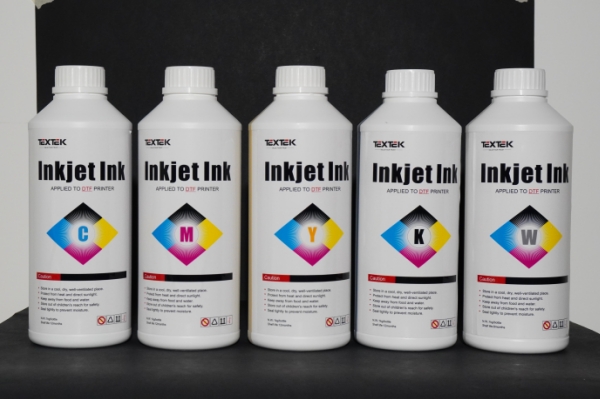
DTF printing uses water-based pigment ink in five channels — Cyan, Magenta, Yellow, Black, and White — applied to PET film and heat-transferred to virtually any fabric. The white ink underbase is the most critical and most misunderstood channel: it determines opacity, color vibrancy, and wash durability on both light and dark garments. This guide covers every aspect of DTF ink: what it is, how each channel works, how to store and maintain it, and how to choose the right ink for your printer.
Key Takeaway: DTF printers use water-based pigment ink — not dye, sublimation, or UV ink. Pigment ink is specifically formulated to bond with hot melt powder and fabric fibers after heat transfer, delivering wash-resistant, full-color prints on any garment regardless of fabric type or color.
DTF (Direct-to-Film) printing uses a specialized water-based pigment ink, sometimes called DTF pigment ink or DTF transfer ink. Unlike sublimation ink (which requires polyester fabric and heat to sublime into fibers), DTF pigment ink is printed onto a PET transfer film, combined with hot melt adhesive powder, cured, and then heat-pressed onto the target garment.
This makes DTF ink compatible with virtually every fabric type — cotton, polyester, nylon, denim, canvas, leather, and blends — and works on both light and dark garments without requiring a pre-treatment step. DTF pigment ink has been the fastest-growing garment decoration ink technology since 2020, largely because it combines the fabric versatility of screen printing with the full-color digital capability of DTG.
Key distinction: DTF ink is a transfer ink — it bonds to the PET film first, then transfers to fabric via heat press. It should never be confused with direct-to-garment (DTG) ink, which is printed directly onto fabric.
Key Takeaway: A standard DTF ink set has five channels — CMYK plus White. The CMYK channels produce all visible color; White acts as a reflective underbase that determines how vividly those colors appear on the final garment. Most printers load double white to compensate for white ink's higher consumption rate.
Here is what each channel does in the DTF printing process:
White ink warning: White DTF ink contains titanium dioxide pigment, which settles rapidly in tanks and tubing. Failing to agitate white ink daily is the single most common cause of printhead clogs, color shifts, and washed-out prints. Gently agitate white ink tanks every day, even when not printing.
Key Takeaway: Premium DTF pigment inks use German solvents, Japanese resins, and high-purity color pigments. This formulation delivers strong fluidity, high color fastness, and clog-resistant performance. Cheap generic inks using lower-grade carriers cause printhead wear, color instability, and poor wash durability.
Professional-grade DTF pigment ink is a water-based dispersion composed of three primary components:
DTF ink is aqueous (water-based) and non-toxic, making it safe for use on children's clothing and home environments. It has good weather resistance and can be applied to both coated and uncoated PET film substrates, giving it broad substrate compatibility.
Key Takeaway: DTF pigment ink offers the fabric versatility of screen printing, the no-pretreatment advantage over DTG, and a wider substrate range than sublimation — all in a digital full-color workflow.
| Ink Type | Process | Fabric Compatibility | Pretreatment | Dark Garments | Wash Durability | Min. Order |
|---|---|---|---|---|---|---|
| DTF Pigment Ink | Print to PET film → heat transfer | All fabrics (cotton, poly, nylon, blends) | None required | ✅ Excellent | 40–60+ washes | 1 piece |
| DTG Ink (textile) | Print directly onto fabric | Cotton preferred (65%+ for best result) | Pre-treatment spray required | ⚠️ Needs pretreatment | 30–50 washes | 1 piece |
| Sublimation Ink | Print to paper → heat sublimate | Polyester only (65%+ min.) | None (but requires polyester) | ❌ Light fabric only | 50+ washes | 1 piece |
| Screen Print Ink (plastisol) | Push ink through mesh onto fabric | Most fabrics | None | ✅ Excellent | 50+ washes | 500+ (plate cost) |
| UV DTF Ink | Print to AB film → peel & stick | Hard surfaces only (glass, metal, plastic) | None | ✅ Excellent | 2–5 years (hard surface) | 1 piece |
Wash durability figures are references under standard home-washing conditions (40°C, inside-out). Actual results vary with hot melt powder quality and heat press parameters.
Key Takeaway: DTF pigment ink must be matched to the printhead type in your printer. Using incompatible ink viscosity or particle size causes permanent printhead damage. Most commercial DTF printers use Epson micro-piezo printheads — the ink's surface tension and viscosity must fall within the printhead's operating specifications.
DTF printers rely on micro-piezo printhead technology, which fires ink by mechanically deforming a piezoelectric crystal. Piezo printheads are preferred for DTF because they handle higher-viscosity inks and pigment particles without the heat degradation that would affect pigment stability.
Textek DTF inks are specifically designed for Epson industrial printheads, including:
Rule: Always confirm ink viscosity and surface tension specifications match your printhead's published requirements before switching ink brands. Mixing ink brands in the same ink system voids printhead compatibility guarantees.
Key Takeaway: Proper DTF ink storage and daily maintenance prevent the majority of printhead clogs, color shifts, and ink waste. The white channel requires the most active management — treat it as a daily maintenance task, not an occasional one.
Storage Conditions
Daily Maintenance Protocol
Key Takeaway: The questions below cover the most common queries about DTF ink selection, compatibility, and performance.
Can I use any water-based pigment ink in a DTF printer?
No. DTF printers require ink specifically formulated for the DTF process — matching the viscosity, surface tension, and particle size specifications of your printhead (typically Epson micro-piezo). General-purpose inkjet inks or dye inks will not bond correctly with hot melt powder and PET film, and may permanently damage the printhead. Always use DTF-specific pigment ink from a reputable manufacturer.
Why do I need twice as much white ink as each CMYK color?
White ink is consumed at approximately 2–3× the rate of each CMYK channel for two reasons: first, it covers the full print area as an underbase layer; second, it often requires a double pass or higher ink density in RIP settings to achieve adequate opacity on dark fabrics. Most DTF ink sets ship with 2× white bottles per CMYK bottle to reflect this usage ratio.
What happens if I run out of white ink mid-print?
Any area printed without a white underbase will appear semi-transparent or faded once transferred to fabric — especially on dark-colored garments. The CMYK color layers depend entirely on the white layer for opacity and vibrancy. Monitor white ink levels before starting long runs and always keep a spare white ink bottle on hand.
Can DTF ink be used on all fabric types?
Yes — DTF pigment ink, when combined with the correct hot melt powder and heat press parameters, bonds to virtually any fabric: cotton, polyester, nylon, rayon, denim, canvas, silk, and blends. This includes both light and dark garments with no pre-treatment required. It cannot be used on hard substrates — for glass, metal, or plastic decoration, UV DTF ink and AB film is the correct process.
How many washes does a DTF print survive?
Under standard washing conditions (40°C, inside-out, gentle cycle), a correctly produced DTF print using quality pigment ink and hot melt powder lasts 40–60+ wash cycles without significant fading, cracking, or peeling. Wash durability is directly affected by heat press parameters (temperature, pressure, dwell time), hot melt powder quality, and ink formulation. Always wash DTF-printed garments inside-out to maximize longevity.
Is DTF ink safe for children's clothing?
Yes. DTF pigment ink is water-based and non-toxic, and does not contain hazardous solvents. Textek DTF inks are formulated to be free from harmful substances and are safe for use on children's garments and home environments. Once cured and heat-transferred, the print layer is sealed and does not release pigment particles into skin contact.
Why does my white ink clog so frequently compared to CMYK?
White DTF ink contains titanium dioxide (TiO₂) particles, which are denser than organic color pigments and settle out of suspension much faster — within hours in a static system. If white ink tanks and tubing are not agitated daily, settled TiO₂ accumulates in the printhead nozzles and causes irreversible blockages. The fix: gently agitate white ink tanks every day and enable circulation if your printer supports it.
Can I mix DTF ink brands in the same printer?
Not recommended. Different DTF ink brands have different viscosity, surface tension, and resin formulations. Mixing brands in the same ink system can cause incompatible inks to react, producing sedimentation, color shifts, and printhead damage. If switching ink brands, perform a full flush of all ink channels with the appropriate cleaning solution before loading the new ink.
DTF printing uses water-based CMYK + White pigment ink formulated for PET film transfer — and every aspect of print quality, wash durability, and consistency flows from the quality and management of that ink. Understanding what each channel does, why white ink demands daily attention, and how formulation affects printhead compatibility turns ink selection from a commodity decision into a competitive advantage.
Textek DTF pigment inks are engineered for Epson industrial printheads, formulated with German solvents, Japanese resins, and high-purity color pigments, and backed by technical support for DTF operations at every scale. For ink samples, compatibility specifications, and pricing, contact us directly.


